Firecracker Micro-VM Isolation vs Container Sandboxing for AI Agents
Hardware-isolated micro-VMs offer AI agents a security boundary containers cannot provide.
Containers were never built to contain what AI agents now produce, and that mismatch is not a matter of degree but of kind. An engineering lead who reaches for a container to sandbox an autonomous agent is making a reasonable decision based on everything containers have historically been good for. The decision is wrong anyway, because the workload in front of them is not the workload containers were designed to isolate.
Containers are not a sandboxing downgrade for AI agents but a category error
Traditional software follows a predictable arc: a developer writes code, someone reviews it, it gets deployed. By the time any of that code executes, a human has already looked at it. Isolation, in that world, exists mostly to keep well-behaved services from stepping on each other, a boundary of convenience between workloads that are all, broadly, trusted. Containers were built for exactly that job, and they do it well.
AI agents break the premise the whole model rests on. An agent generates code dynamically, in response to a prompt, a goal, and whatever context it has absorbed along the way, and that code runs before any person or static review process has seen it. Nobody vetted it. The runtime has no history with it. A sandbox built for this situation has to assume, as a baseline operating condition, that every execution could be hostile. A 2026 sandboxing guide states this as a design principle rather than a precaution: effective sandboxing for AI-generated code treats all of it as potentially malicious, with actions explicitly allowed one by one rather than implicitly permitted by default, which inverts how most container deployments are actually configured.
Prompt injection is what makes this more than a theoretical concern. An attacker doesn't need network access or a foothold on the host to cause damage. Control over some fraction of the agent's input context is enough to steer what code the agent writes and executes. The attack surface here is the agent's reasoning layer, not the infrastructure sitting underneath it, and that's a surface containers have no mechanism to defend, because containers were never designed to police the content of the code running inside them, only the resources it can touch.
What Containers Guarantee
Containers give real guarantees, and it's worth being precise about what those are before explaining why they stop short for agent workloads. Linux namespaces partition what a process can see: its process tree, its network interfaces, its filesystem mounts. Cgroups limit what it can consume: CPU, memory, I/O bandwidth. Both mechanisms are enforced by the host kernel, and every container on a given host shares that same kernel.
This shared kernel is a deliberate design decision, not an oversight or a weak default somebody forgot to harden. It's the design decision that makes containers fast and dense in the first place, trading isolation depth for startup speed, a trade-off that makes complete sense for trusted workloads and stops making sense the moment the workload cannot be trusted.
The historical record shows the consequence cleanly. If the host kernel has a vulnerability, that vulnerability exists simultaneously inside every container running on that host. A successful container escape via a kernel exploit doesn't just compromise the one container where it originated, it exposes the entire host. A concrete case is CVE-2019-5736, a runc escape: an attacker inside a container overwrites the host's runc binary and gains execution on the host itself, requiring only that the container process runs as root, UID 0. That single exploit chain demonstrates the entire class of risk the shared-kernel model carries.
Hardened containers push back against this with seccomp profiles, dropped capabilities, and other policies, all of which restrict the syscalls a container is allowed to make. These are real improvements, and they shrink the attack surface meaningfully. But they operate as a denylist: they close off specific dangerous paths without changing the underlying condition that makes those paths dangerous in the first place, the shared kernel itself. For AI agents, that denylist model has a particular weakness. The agent reasons in userspace, the same space where seccomp rules are defined and enforced, and a sufficiently capable or manipulated agent can probe for the gaps a denylist inevitably leaves, chain together permitted syscalls into sequences that were never individually blocked, or aim directly at whatever kernel surface the denylist didn't anticipate.
How Firecracker's isolation boundary works
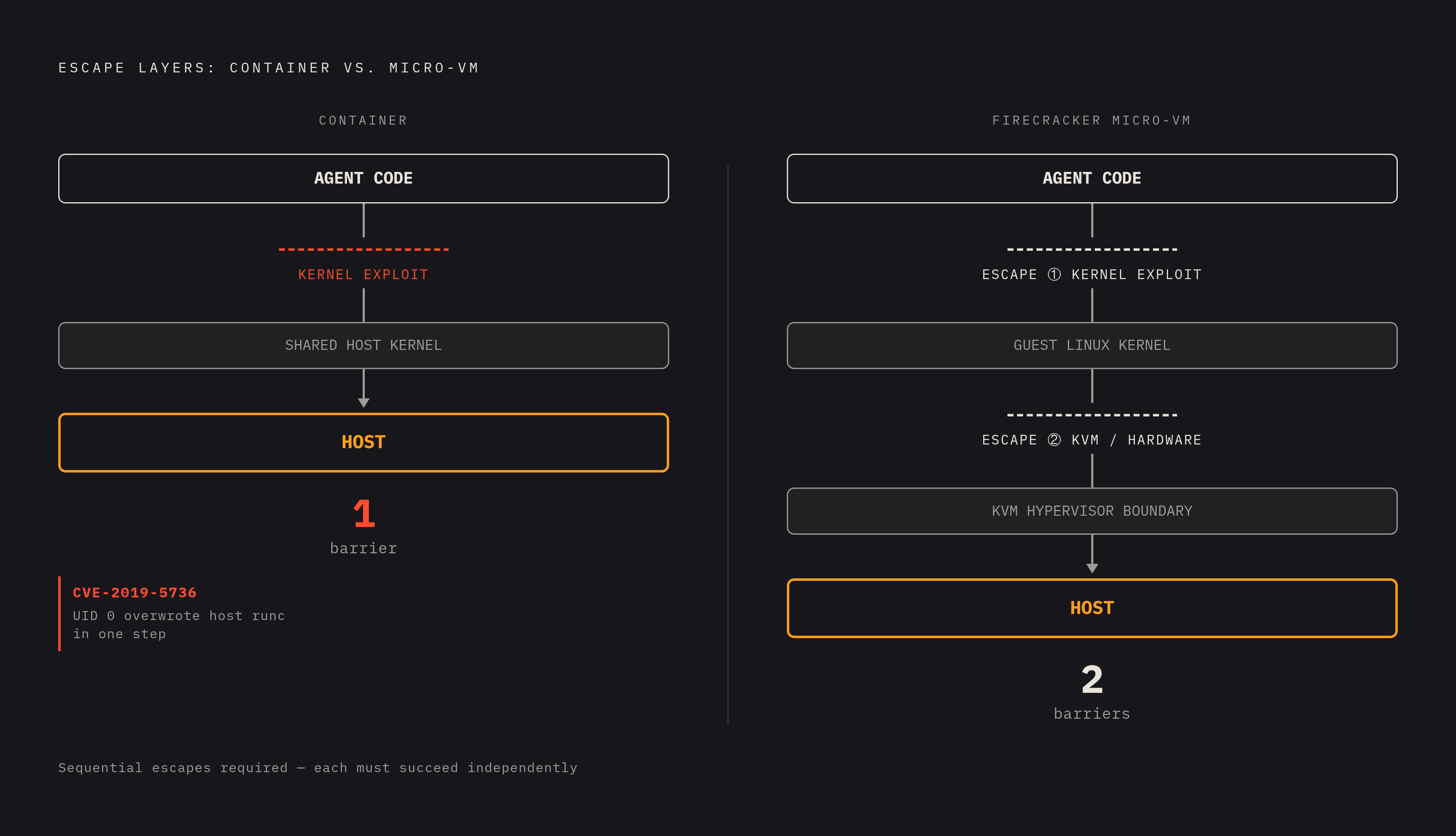
Firecracker moves the isolation boundary to hardware, a layer the agent cannot reach. Each micro-VM runs its own guest Linux kernel inside KVM, so a kernel exploit that succeeds inside the sandbox compromises only that guest's kernel, never the host's.
That changes the shape of the attack an adversary has to pull off. Reaching the host now takes two separate escapes in sequence: first out of the guest kernel, then past the hypervisor boundary itself, which is enforced in hardware rather than in software the guest can influence. A compromised agent reasoning inside the guest has no path to that layer, because it isn't software at all from the guest's point of view.
Firecracker's design choices reinforce this hardware boundary rather than substituting for it. The VMM emulates a minimal set of devices, specifically what serverless workloads actually need, which keeps the VMM's own attack surface a fraction of what a general-purpose hypervisor like QEMU exposes with its VGA, USB, and BIOS emulation. Each micro-VM boots with its own kernel, fully separated from the host, in approximately 125ms, using under 5 MiB of memory overhead per VM. Those numbers matter less as performance trivia than as evidence that hardware-level isolation doesn't require heavyweight virtualization to achieve.
The open-source agent-sandbox project shows what this looks like assembled into a full stack. The agent-sandbox open-source project illustrates the full isolation stack in practice: each session gets a dedicated Firecracker micro-VM with its own guest Linux kernel, a per-VM network namespace with an isolated veth pair and TAP device, iptables rules that block cross-tenant VM traffic at the host level, and a vsock channel for host-to-guest IPC that never traverses the network stack. The guest filesystem in that implementation runs as an in-memory tmpfs, so no guest write ever persists to host storage by default, and even a guest that's fully compromised leaves no durable trace on the host once the session tears down.
That's precisely why controls living in userspace, containers and seccomp among them, fail at the boundary where it matters, while controls enforced in hardware, below where any subprocess can act, hold regardless of what the subprocess attempts.
Where gVisor fits between containers and micro-VMs
gVisor occupies real territory between containers and micro-VMs rather than functioning as a weaker version of either. Its mechanism is a user-space kernel, called Sentry, that sits between the container and the host kernel. Agent code makes its syscalls to Sentry, which handles them in user space and only passes a minimal, vetted subset through to the actual host kernel, eliminating the direct syscall path that most container escapes depend on.
gVisor buys real security improvement without touching hardware.
That improvement comes with a performance cost that varies by workload. The practical overhead of the Sentry interception is meaningful for I/O-heavy workloads, in the range of ten to thirty percent, but for compute-heavy AI inference the penalty is smaller. That smaller penalty makes gVisor a reasonable choice for certain multi-tenant SaaS and CI/CD workloads.
Where gVisor runs into a harder limit is GPU access. A guide from Spheron, published in April 2026, explains that gVisor's user-space kernel intercepts GPU calls at a point that blocks direct PCIe passthrough, while Firecracker's hardware virtualization path supports VFIO device passthrough straight to the micro-VM, giving the sandbox near-native GPU performance. For agents running PyTorch, JAX, or raw CUDA kernels inside the sandbox, that's a decisive gap. It is not, however, an unsolvable one. At least one major managed sandbox platform runs gVisor as its isolation layer and still delivers GPU access inside the sandbox itself, which indicates the passthrough limitation is an engineering problem that can be solved with enough investment, not a hard architectural ceiling.
How snapshot-restore changes the operational cost of micro-VM isolation
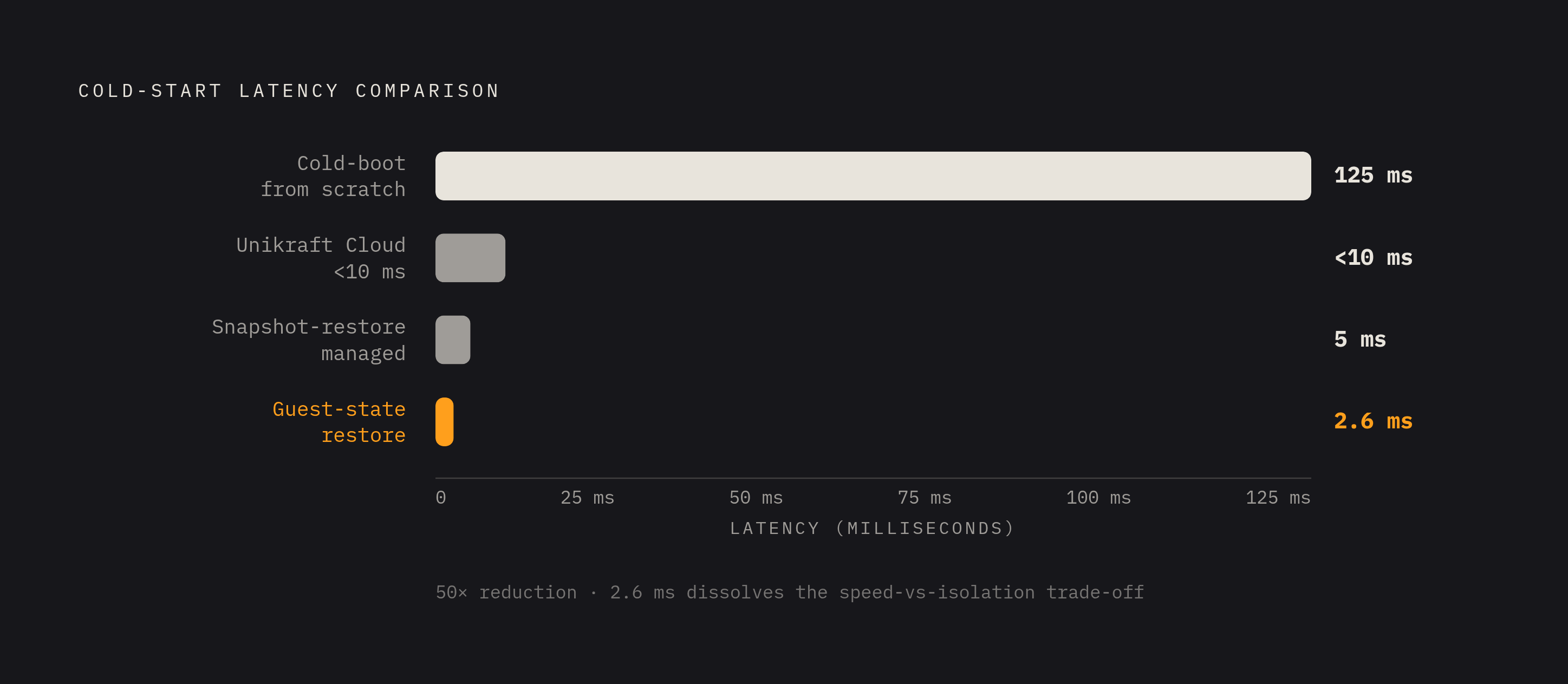
The strongest practical objection to micro-VM isolation has always been speed. A Firecracker micro-VM booting from scratch takes approximately 125ms, which is fine for batch jobs but adds real latency to an interactive agent session, and it makes sandboxing every single tool call feel uneconomical at any meaningful scale.
Snapshot-restore answers that objection by changing what "booting" actually means in production. Instead of cold-booting a fresh micro-VM for every session, the platform boots one micro-VM to a ready state a single time, snapshots its memory and block device state, and restores every subsequent sandbox from that snapshot rather than booting it from zero. That shift moves effective cold-start time from around 125ms into the tens of milliseconds, and in some implementations, far below that. One managed platform achieves cold starts as low as five milliseconds from snapshot restore, and the open-source agent-sandbox project reports guest state restoring in approximately 2.6ms, with a sub-100ms end-to-end cold start once network namespace provisioning is included.
Multi-turn agent sessions gain something beyond raw speed from this approach. Because snapshot-restore preserves memory and filesystem state across turns, an agent working through a long sequence of tool calls keeps its installed packages, its written files, and its intermediate outputs intact, with no need to reinitialize the environment at every step.
The economics this unlocks extend further than per-session latency. Because restoring from a snapshot is cheap, giving each individual user or session a fully dedicated micro-VM stops requiring a trade-off against fleet-wide cost. Isolation depth and scale, which used to pull against each other, stop being in tension once restore cost falls this low. The awesome-sandbox reference describes Unikraft Cloud's heavily modified Firecracker VMM reaching sub-10ms cold starts and sub-10ms scale-to-zero while running over 100,000 isolated instances per server, evidence that snapshot-restore isolation scales to real production fleet sizes rather than remaining a lab result.
Isolation Guarantees Against AI Agent Threat Vectors
The threat vectors that matter for AI agents are structurally different from what containers were ever asked to defend against. Prompt injection manipulates what code the agent generates from inside its own reasoning layer. Kernel exploits target the kernel that containers share across every tenant on a host. Cross-tenant data access becomes possible the moment a compromised agent can read another tenant's filesystem. Credential exfiltration happens whenever environment variables or mounted secrets are reachable from inside a compromised sandbox. Standard containers don't meaningfully address any of these at the isolation layer: an agent manipulated by prompt injection into generating a kernel exploit payload is left unconstrained by namespace isolation, because the exploit targets the kernel the namespace never protected.
Isolation depth and authorization enforcement solve different problems, and conflating them is a mistake. A paper on pre-action authorization for autonomous agents, the OAP paper, submitted to arXiv in March 2026 under identifier arXiv:2603.20953, draws a distinction that matters here: sandboxed execution limits the blast radius once an attack succeeds, but it does nothing to stop an unauthorized action from being attempted in the first place. The paper's adversarial testbed found social engineering succeeding against the model 74.6% of the time under a permissive policy, a result that demonstrates isolation alone does not close the authorization gap. Sandbox isolation and pre-action authorization are complementary layers, not substitutes for each other, and a platform that treats isolation as sufficient on its own has left half the problem unaddressed.
gVisor addresses the kernel exploit vector by interposing the Sentry between agent code and the host kernel, so a kernel exploit payload generated by the agent hits the user-space Sentry rather than the host kernel, but gVisor does not create a hardware boundary, so a Sentry vulnerability or a sufficiently sophisticated attack on the syscall interception layer remains a path to the host. Micro-VMs push the same vector down to hardware: an exploit that escapes the guest kernel still has to get past a VMM boundary enforced by CPU virtualization instructions, and that two-stage escape requirement is a structural guarantee no lower isolation level can match.
Cross-tenant isolation tracks the same logic. Containers on a shared host rely on namespace separation around a single shared kernel, adequate when tenants carry low risk relative to each other but insufficient the moment tenants cannot trust one another. Micro-VMs give each tenant an entirely separate kernel with no shared kernel state between them, making micro-VMs the industry standard for compliance-sensitive multi-tenancy. Credential exfiltration resolves differently at each layer too: hardened containers can restrict filesystem and environment access through capability dropping, but a kernel exploit bypasses those controls entirely because the kernel they rely on is shared, while micro-VMs isolate the guest's view of storage and environment at the virtualization layer itself, so a fully compromised guest still cannot read host environment variables or another guest's block device.
How production platforms have drawn the isolation line
Production platforms have already made these calls, and the calls track the threat-model reasoning laid out above rather than contradicting it.
An open-source, Firecracker-based managed runtime built specifically for AI agents achieves snapshot-restore cold starts of roughly five to thirty milliseconds under best-case conditions, though real-world p50 cold starts typically run around 150 to 200 milliseconds or higher. Its managed tier is CPU-only, with no GPU passthrough, though a self-hosted open-source path exists for teams that need GPU workloads on bare metal. A reference guide to sandbox platforms notes claims of Fortune 100 adoption at that scale.
AWS Bedrock AgentCore, which reached general availability in October 2025, takes the one-session-one-micro-VM model and runs it for sessions up to eight hours long, destroying and sanitizing each micro-VM after use, integrated with Bedrock's services. In April 2026, AWS extended this with a managed harness, in public preview, that lets a developer define an agent by its model, system prompt, and tool set and run it inside that same isolation model.
What these choices reveal is consistent: platforms built explicitly for AI agent workloads have converged on micro-VM isolation as the baseline, treating hardware-enforced boundaries as the starting assumption rather than an upgrade reserved for the most sensitive tenants. That convergence reflects the same reasoning this piece has traced from first principles, the shared kernel is the vulnerability, and the agent's own reasoning layer is close enough to that kernel that only a hardware boundary sits reliably out of its reach.
Sources
- AI Agent Code Execution Sandboxes on GPU Cloud: E2B, Daytona, and Firecracker Setup Guide (2026)
- GitHub - restyler/awesome-sandbox: Awesome Code Sandboxing for AI · GitHub
- Before the Tool Call: Deterministic Pre-Action Authorization for Autonomous AI Agents
- GitHub - vivek1504/agent-sandbox: Give any AI agent its own disposable Linux machine. Firecracker microVM sandboxing with millisecond boot times, full network access, and native MCP support. · GitHub