Audit Logging for Actions Taken by Isolated AI Agents
Host-side isolation logs what agents do without trusting their own records.
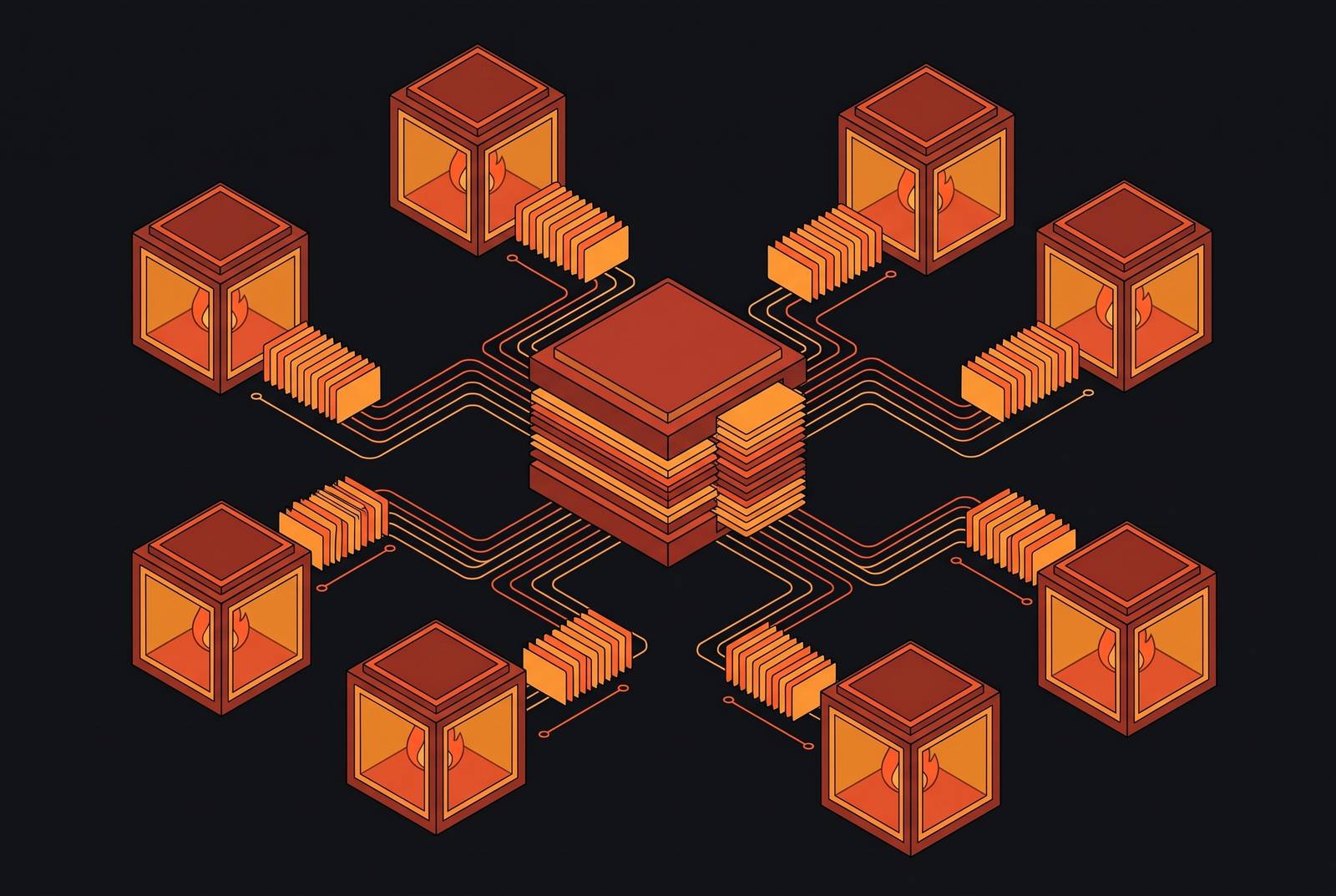
Firecracker micro-VM isolation for AI agents gives each agent its own kernel under hardware virtualization, so agents do not share a container kernel. For audit logging, that separation gives host-side infrastructure a perimeter where it can record what the agent does without the agent controlling the record. Trustworthy evidence requires more than isolation, however. Boundary capture must be combined with persistent identity, cryptographic sealing, and replayable records.
Why existing tracing infrastructure fails autonomous agents as a governance record
A trace shows how a run unfolded, while evidence lets others check it for themselves. That distinction exposes an architectural gap in conventional observability. A production agent is a graph of independently versioned parts, including model weights, prompts, tools, retrieved context, and its environment. When an outcome is challenged, a record must connect those parts to the action under review. Detailed traces alone do not establish that connection or prove that the record is intact.
NovaFabric describes traces as mutable analysis artifacts that can be altered without detection, lack a recipe for re-execution, and do not attest to the removal of captured secrets. More logging does not fix those properties. Agent Security Meets Regulatory Reality (A Practitioner Systematization of Autonomous-Agent Threats and Controls in Regulated Financial Systems) describes a similar failure in a KYC system that was in use. Tool-call logs existed, but an audit starting from a case identifier could not reconstruct which document retrievals and policy checks drove the decision.
What a complete audit log for an isolated agent must actually capture
A complete record must connect intent, authority, execution, and outcome. It must capture the triggering request and principal, agent identity and version, the model’s reasoning trace, every tool call with full inputs and outputs, each policy decision, and the final result. Blocked and failed actions belong in that record. Without them, the history omits where controls intervened or execution broke down. In regulated financial settings, it must also identify the exact policy versions used to reach a case outcome.
Identity gives these events a durable subject. The 2026 Singapore Consensus on Global AI Safety Research Priorities calls for agent identifiers that are unique and can be verified, along with delegation-chain logging. The Cloud Security Alliance’s Agentic AI IAM guide also calls for logs to link significant actions to a unique, persistent identifier. In multi-agent deployments, the orchestration operator must keep a trail that links what agents do, even when they cross organizational boundaries.
Coverage must also be declared and measured explicitly. NovaFabric reports completeness of 0.652 against each scenario’s declared evidence streams, with missing event categories bounding the result. Nightfall AI identifies local stdio MCP servers as a blind spot for network-based inspection. Consequently, a coverage claim must distinguish local stdio from remote MCP transports rather than treating all tool activity as network traffic.
Why the isolation boundary is where logging belongs, not the application layer
If an agent can modify its logging code or suppress selected emissions, its account cannot independently establish what happened. Application-layer logging remains useful for observability, but that is a different claim. Verification requires a collector outside the agent’s trust domain.
Isolation supplies the separation that this trust model needs. A logging SDK inside the agent’s environment cannot give it that separation just by writing detailed events. A host-side collector at a micro-VM perimeter can instead record boundary activity without accepting the agent’s choice about whether to report it. The Singapore Consensus treats auditability as a design-time principle, requiring decisions and actions to remain reconstructible and verifiable throughout and after execution. For this architecture, the isolation boundary is therefore the primitive on which trustworthy capture is built.
How do you give each AI agent its own isolated kernel for audit logging?
Firecracker, Kata Containers, and libkrun provide micro-VM-based options for separating workloads with their own kernels. They use hardware virtualization, including KVM on Linux and, for libkrun, HVF on macOS. Containers instead share the host kernel. For logging, the decisive distinction is the placement of the collector outside the guest, where guest-controlled code cannot directly rewrite its record. The perimeter separates execution from the infrastructure responsible for observing it.
That perimeter supports instrumentation of filesystem mutations, outbound network calls and their targets, process spawning, and checkpoint memory snapshots. Capture still has to connect observed activity to tool calls, policy decisions, and agent identity, including local activity that network inspection misses. NovaFabric demonstrates system-boundary capture without modifying agent logic, producing a portable Run Capsule over a fifteen-entity schema.
Networking provides a concrete host-side observation point. TAP interfaces, IP tables, and routing require explicit host configuration, so guest egress traverses infrastructure the agent does not own. Snapshot and restore provide another instrumentation point. A full memory and disk image at a checkpoint can become a forensic artifact, sealed and timestamped independently of the agent’s own logging.
What tamper-evidence and replayability require beyond capture
A captured event is not yet verifiable evidence. Hash chaining makes retrospective changes detectable, while signing and trusted timestamping bind the record to a verifiable seal. NovaFabric uses NovaSeal to apply a DSSE signing envelope to the whole session, bind it to an RFC 3161 timestamp, and record it in an append-only Merkle log. The contribution integrates existing primitives, including OpenTelemetry, DSSE/in-toto, and W3C PROV.
Redaction must preserve an account of the transformation. A signed redaction attestation can state that a secret was removed without exposing the secret itself. That lets a recipient distinguish a deliberate, attested removal from an unexplained omission. It does not recover content that capture missed. An evidence bundle must show both how complete the record is and whether it has kept its integrity.
Replay imposes a further requirement on the record. NovaFabric’s four-mode replay protocol includes mocked replay that serves recorded model responses from the capsule, but only 2 of 10 tool-using workloads completed replay. The reported gap came from missing tool-response substitution, so how to replay real tool side effects remains an open implementation problem. Verification also depends on key custody. A custodian who can sign a false capsule can get it past downstream checks without breaking the cryptography.
How persistent agent state changes what the log must cover across sessions
A persistent agent’s history extends beyond any single invocation. Its filesystem, memory, and running processes survive through standby, so the audit record must describe sleep, snapshot, and restore as execution events. Each checkpoint establishes what state existed at pause time. The next invocation must identify the snapshot from which it resumed, allowing a provenance query to follow the causal chain across sessions.
Persistence keeps the state from one session to the next, while isolation lets infrastructure outside the agent’s control seal the checkpoint. A stateless environment that destroys its context cannot itself provide a continuous memory and filesystem history between calls. An application-level identifier may connect requests, but it does not prove continuity of execution state.
Sealing checkpoints also has an operational cost to account for. Repeated checkpoint and restore operations add overhead, and audit design must include the first, intermediate, and last checkpoints. Hibernation combines a paused execution environment with a forensic boundary. Its sealed snapshot becomes the authoritative state-at-rest artifact that the cross-session record references.
Regulatory requirements that the isolation-based logging architecture directly satisfies
The EU AI Act Article 12 establishes a logging duty for high-risk AI systems. Architecturally, automatic records require capture that does not depend on an agent volunteering its account of consequential activity. ISO/IEC 42001 also places governance records within the accountability framework described in the brief. These obligations differ from voluntary guidance. NIST AI RMF encourages documentation and independent assessment but imposes no mandatory audit or certification requirement.
The Singapore Consensus makes reconstructibility and verifiability explicit in its auditability principle. In financial services, the financial-systems paper describes a more specific evidentiary need, namely reconstructing the principal reasons for a credit outcome in a consumer-disclosable form. Meeting that requirement takes grounded-RAG-for-audit and case-ID propagation as well as event storage that can be searched. Internal audit found a stale policy in the retrieval store that caused systematic over-verification. Recording the retrieved policy version with the case that used it would give an audit the evidence needed to look into that failure.
These requirements shape capture, attribution, and retention. Nightfall AI notes that separating human and agent actions in audit trails can simplify compliance reporting. Origin labels, policy versions, and case identifiers therefore belong in the record from the outset. Isolation-based logging helps meet these obligations without depending only on self-reporting, though isolation alone does not make a system legally compliant.
Designing the logging pipeline from boundary event to sealed, exportable evidence bundle
The collector sits at the hypervisor or host side of the micro-VM perimeter, with instrumentation for syscalls, network egress, filesystem mutations, and process events. Each event receives the agent’s persistent identifier and snapshot lineage. Capture must cover what local tools do as well as remote traffic.
Schema normalization follows capture and makes the record portable. Raw events map into a structured, self-describing format covering the entity types identified by NovaFabric, including model calls, tool calls, policy events, environment locks, and human approvals. This is where low-level observations become a connected execution history. The schema must preserve the inputs and responses needed to reconstruct actions after the original model version or vendor environment is gone.
Append-only storage then protects the ordered event history. Each normalized entry commits to its predecessor through hash chaining, using SHA-256 at minimum, so retrospective modification is detectable without consulting the original collector. Cryptographic sealing follows at the session level. A DSSE envelope signs the completed record, an RFC 3161 timestamp binds it to trusted time, and an append-only Merkle transparency log records the root hash. The record can be verified without having the signing key.
Redaction-attested export is the final pipeline stage before sharing. Credentials and secrets are removed with signed attestations, and the resulting bundle must be verifiable with stock tooling. Replay serves as a design test across these stages. Mocked replay needs recorded model responses, and tool-using runs also need the response substitution that was missing in NovaFabric’s evaluation.
Trust in the bundle still depends on who holds the signing keys. Signing keys must be rotated, audited, and hardware-protected as part of the logging design. Those controls protect the authority that seals the evidence. They cannot turn a false record signed by a trusted custodian into a truthful one, which is the limit the verification model must disclose.
How persistent, VM-isolated agent infrastructure makes this pipeline operationally viable
A persistent micro-VM provides the runtime surfaces this pipeline needs. Its own kernel separates guest execution from host-side collection, its persistent disk supports continuity, and snapshot-restore semantics provide checkpoints that can be sealed. Those properties make the pipeline implementable without asking the agent to maintain its own authoritative history. They do not automatically implement the schema, cryptography, or custody controls.
Stateless execution lacks an environment to instrument between invocations. A shared container environment also has no separate guest-kernel boundary, so where the collector sits and how the shared-kernel trust model works are central concerns. A persistent VM, in turn, links the activity the host observes to an execution identity that lasts across sessions. Hibernation strengthens the operational fit because idle agents retain stored snapshots and leave active compute unused. The same artifact supports both state preservation and forensic reconstruction.
Per-user VMs further separate the provenance of each user’s agent. Their distinct environments reduce shared-state ambiguity and support per-user reconstruction without depending solely on filtering a common execution history. The Singapore Consensus identifies audit capability as an infrastructure concern within its priority on institutions and infrastructure for agents. The resulting design principle is straightforward. Audit-grade evidence is not a compliance add-on to agent execution, but a capability the isolation layer can provide when capture, continuity, and verification are built into it.