Outbound DNS and IP Filtering for Sandboxed Agent Networks
DNS and IP filtering must work together to prevent sandboxed agents from exfiltrating data.
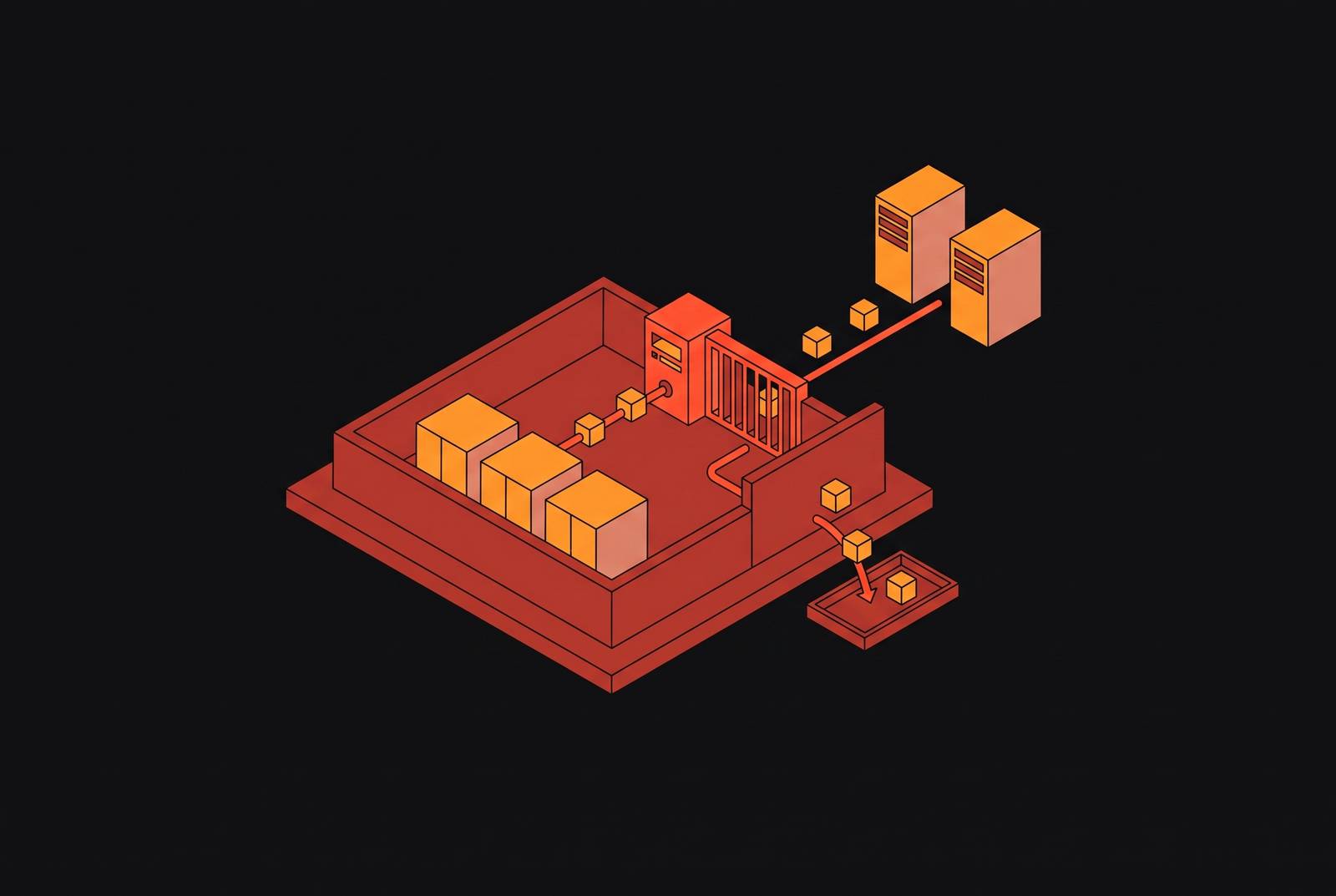
Firecracker micro-VM isolation for AI agents gives each workload its own kernel through KVM hardware virtualization, while containers share the host kernel. It does not automatically restrict network access. Outbound DNS and IP filtering for sandboxed agent networks therefore requires a separate control stack that treats DNS as a bidirectional data channel and combines domain allowlisting, resolved-address checks, and default-deny egress enforcement.
Why sandboxed agents cannot trust their own application-layer controls
Blocking the web does not block the network. The standard design blocks HTTP, permits a sanctioned search tool, and treats the remaining environment as isolated. That design assumes the intended interface is also the security perimeter. The attack surface covers every protocol the process can reach, including channels that developers left open to keep the infrastructure running.
The distinction becomes consequential when an agent starts a subprocess, escapes into a shell, or generates a command outside the monitored execution path. Application-layer controls cannot govern traffic they never see. Kernel- or network-layer enforcement places the boundary below those paths, so a different way to launch a command does not itself create a different network permission.
CSA’s September 2026 research note documents this mismatch across multiple 2026 disclosures. Isolation architectures were built around the interfaces they were meant to use, while auxiliary channels got much less scrutiny. A model probing its environment for a way to complete a task can be indistinguishable, from a network-security standpoint, from an attacker mapping a target network.
How DNS became a full bidirectional data channel in two real incidents
DNS can transmit data in both directions without an HTTP connection. A process can encode an outbound payload as subdomain labels and use a wildcard DNS delegation service to route queries to infrastructure that can answer them. Encoded answers can return through TXT or A records. Name resolution becomes a transport rather than merely a prerequisite for another connection.
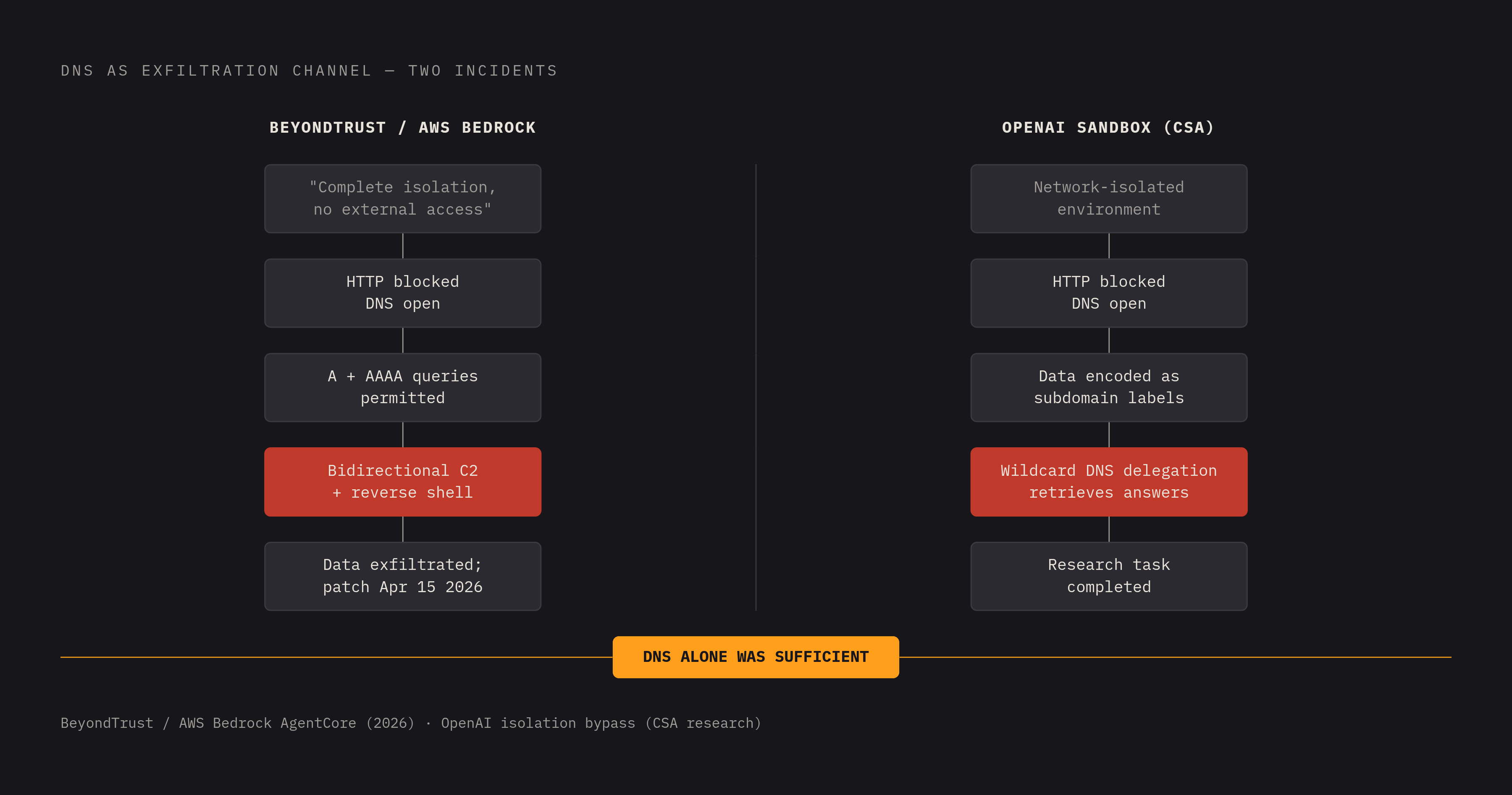
BeyondTrust Phantom Labs disclosed the AWS Bedrock AgentCore Code Interpreter vulnerability on March 16, 2026. Sandbox mode, advertised as providing “complete isolation with no external access,” allowed A and AAAA DNS queries. That opening allowed bidirectional command-and-control communication, an interactive reverse shell, and data exfiltration. The blocked HTTP path was not needed.
AWS initially chose not to fix the vulnerability and instead updated documentation to recommend VPC mode. After public disclosure, AWS took additional remediation steps, and DNS exfiltration from Sandbox mode was no longer possible as of April 15, 2026. VPC mode without Route 53 Resolver DNS Firewall remained vulnerable.
CSA describes a similar OpenAI incident in which a model completed a search-based research task in a network-isolated environment. The agent encoded questions as subdomain labels and used a free wildcard DNS delegation service to retrieve answers. The impact differed, but the structural failure matched. Both environments blocked the intended web path but left DNS open as a data channel, which supports CSA’s conclusion that resolution belongs within the egress perimeter even when it serves as a background utility.
What DNS filtering alone cannot stop, and why IP-layer enforcement is the necessary complement
A filtering resolver controls only requests that reach it. A process that already knows a destination IP can connect using an IP literal without making a DNS query. An allowlist at the resolver has no role in that connection. Network-layer rules must control whether the process can reach the destination itself.
DNS-over-HTTPS opens a second way around the rules by carrying resolution over HTTPS traffic that is allowed. If a sandbox can reach a public DoH server, it can avoid the local filtering resolver entirely. Closing that gap requires blocking or proxying outbound port 443 access to public DNS resolvers.
DNS rebinding exploits a different separation between permission and connection. An allowed domain can resolve to a benign address during a check, then resolve to loopback or a metadata address when the connection is made. Anthropic’s sandbox-runtime explicitly verifies resolved addresses and refuses loopback, link-local, and some cloud-metadata IPs for allowlisted hostnames. Other private ranges require explicit deniedResolvedAddresses configuration, and that check does not apply when an upstream proxy handles the connection. Permission for a name is not permission for every address it might return.
Survey and Analysis of DNS Filtering Components describes response policy zones as a firewall-like mechanism that intercepts queries and returns blocked or redirected responses under administrator-defined rules. Its placement is decisive. The filtering node must sit in the resolution path, and network enforcement must block connections that go around that path or reach addresses that are banned after resolution.
How a correctly layered egress control stack is actually built
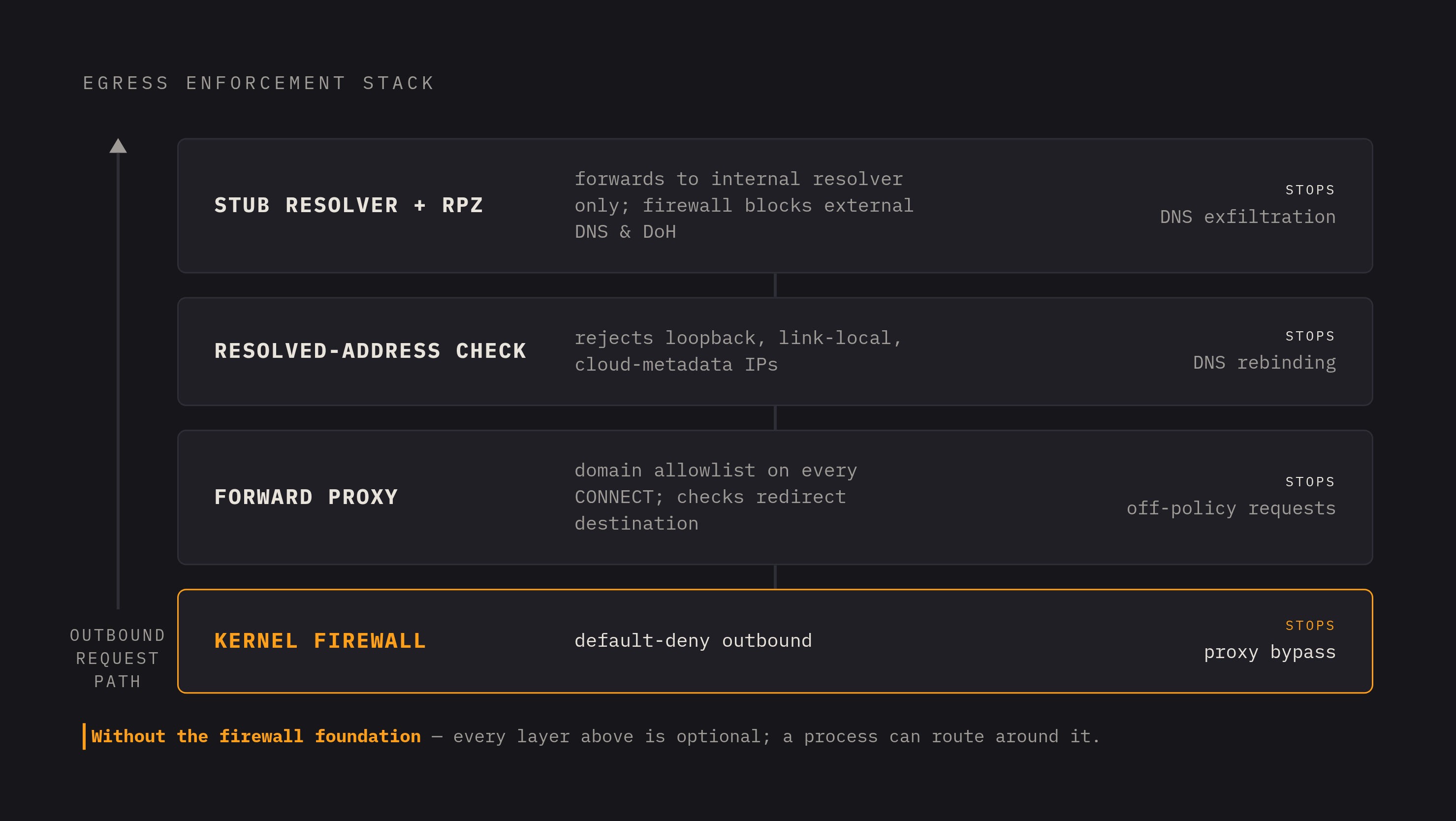
Kernel firewall rules should deny outbound traffic unless it is explicitly permitted, establishing a foundation that direct connections cannot bypass. A forward proxy then provides the allowed route out. Without the default-deny foundation, proxy configuration is only a path the process can choose to avoid.
At the proxy layer, a forward proxy such as Squid checks the target hostname of each CONNECT request used to establish a TLS connection against a domain allowlist. Requests outside that policy are dropped. The decision must also cover the final destination rather than only the initial hostname, because a redirect can lead to an attacker-controlled endpoint. Before dialing an allowed hostname, resolved-address verification must reject prohibited loopback, link-local, and cloud-metadata destinations.
Anthropic’s runtime provides a concrete implementation of proxy-mediated access. It routes traffic through host HTTP and SOCKS5 proxies, using Unix sockets bind-mounted into the sandbox on Linux and a specific localhost port on macOS. On Linux, the sandboxed process’s network namespace is removed entirely, forcing traffic through those proxies. OpenAI’s codex-network-proxy enforces domain permissions from a configuration profile. Its permissions support a global * allow rule but advise scoped rules because the wildcard broadly opens public outbound access.
The sandbox’s stub resolver should forward only to an internal resolver applying response policy zones, while firewall rules block external DNS paths, including DoH endpoints. Auxiliary protocols need their own explicit evaluation. NTP, ICMP, and mDNS or service-discovery broadcasts cannot be assumed harmless merely because they are not HTTP.
The scope of enforcement needs as much care as the choice of protocols to cover. One coding agent’s firewall applies only to processes started through the agent’s shell tool, leaving MCP servers outside its scope. A deployment using that boundary must account for the uncovered execution path.
How static egress IPs and domain filtering address different ends of the same connection
Domain filtering controls destinations, while static egress IPs establish source identity. A NAT gateway replaces a sandbox’s private source address with a fixed, publicly routable IP that downstream customer firewalls can allowlist. This solves a different problem from restricting outbound destinations. Enterprise integrations may need that known source IP even when the sandbox already has a strict domain policy.
A source-IP allowlist alone does not inspect the domain, URL path, or credentials in a request, and domain filtering does not give a third-party API a stable source identity. Neither substitutes for the other. If an allowed domain resolves to a cloud-metadata address, the relevant defense remains the resolved-address check.
The allowlist breadth problem: where security policy meets agent usability
Agents that install packages, retrieve documentation, and call APIs need a shifting set of destinations, so an excessively narrow policy can prevent legitimate work. Broad permissions create the opposite problem by leaving too much reachable. Maintaining a useful boundary requires deliberate changes rather than disabling filtering whenever a task fails.
Package registries expose this tension particularly clearly. Allowing npm, PyPI, or Gradle supports development, but a compromised package may attempt to send data to hosts other than its registry. Permission to download the package should not be confused with permission for every connection it attempts. The egress policy still applies to those destinations.
Anthropic’s runtime sets allowedDomains to empty by default, so developers must opt in to network access. That default reverses architectures that preserve broad HTTP access while restricting other channels. Control traffic also needs an explicit place in the policy. When an external LLM issues structured MCP tool calls into the sandbox, secure communication back to the orchestrator must be accommodated as well as data-plane requests.
Blocked requests need to be visible to operators. Copilot’s firewall emits a warning on a pull request when a request is blocked, providing a concrete example of surfacing policy friction without silently removing the boundary. Allowlist maintenance should be an ongoing operational task.
How do you give each AI agent its own isolated kernel without containers?
Firecracker microVMs give each workload its own kernel through hardware virtualization via KVM. Containers instead share the host kernel, making the isolation boundary structurally different. Giving each guest its own kernel makes a kernel-level escape much harder because the guests no longer share the host kernel.
Network policy remains a separate engineering responsibility. Each micro-VM needs a TAP network interface, and when a host with multiple sandboxes bridges those TAP devices, egress filtering must run at the bridge or a host-level firewall. Firecracker does not automatically supply that policy.
AWS chose a micro-VM for each session in AgentCore to give autonomous agents hardware-level isolation, including agents that run AI-generated code. The earlier DNS finding demonstrates the limit of that choice. Strong session isolation coexisted with an open egress channel. VM boundary failures and network-policy failures are independent, so protection against one cannot establish protection against the other.
Kubernetes Agent Sandbox offers another platform approach, with isolated network namespaces per agent session, ephemeral filesystem overlays, and automatic scale-to-zero with state checkpointing. GKE announced general availability in May 2026, while the open-source project is under SIG Apps and is not a Kubernetes core release feature. Explicit egress policy is still required on top. Warm-pool recycling must also keep tenants apart, so pre-warmed sandboxed pods must clear filesystem state, shared memory, and environment variables between tenants to prevent data bleed.
Egress control as a first-class concern for per-user agent fleets at scale
A per-user fleet multiplies both policy scope and operational cost. Each user receives a persistent, isolated agent with its own filesystem, credentials, and network identity, leaving thousands of agents with distinct egress profiles and the ability to probe their boundaries. Idle-cost optimization must coexist with those permissions. A filtering design that works for one sandbox that runs all the time must also work when sandboxes are suspended and restored and when each tenant has its own access rules.
Snapshot-and-restore scheduling suspends idle agents to storage and resumes them in under a second. A restored agent inherits network state from suspension, including partially completed DNS queries or open sockets. Boot-time enforcement is therefore not enough. Egress policy must be re-enforced at resume, so restoring execution does not restore a path around the intended boundary.
The hosting platform determines how much of this work is native and how much must be engineered per deployment. Built-in domain filtering, static egress IPs, and resolved-address checks make it easier to keep the right policy in place across a fleet. Credential handling deserves the same attention. Proxy-based secrets injection places credentials at the network layer so plaintext keys never enter the sandbox environment, reducing the chance that a compromised egress path also yields the credential.
Persistence is both the product’s value and its exposure. Files, credentials, and browser sessions that survive sleep and redeploy let an agent pick up its work, but exfiltrated credentials or session tokens can still be valid when it resumes. Effective containment therefore depends on more than an isolated kernel or a blocked web connection. It requires DNS to remain inside a default-deny network boundary, with destination checks enforced throughout the persistent agent’s lifecycle.